Macroeconomic Policy Shifts: Trump's Bond Purchase Program and Venezuela's Bitcoin Mystery
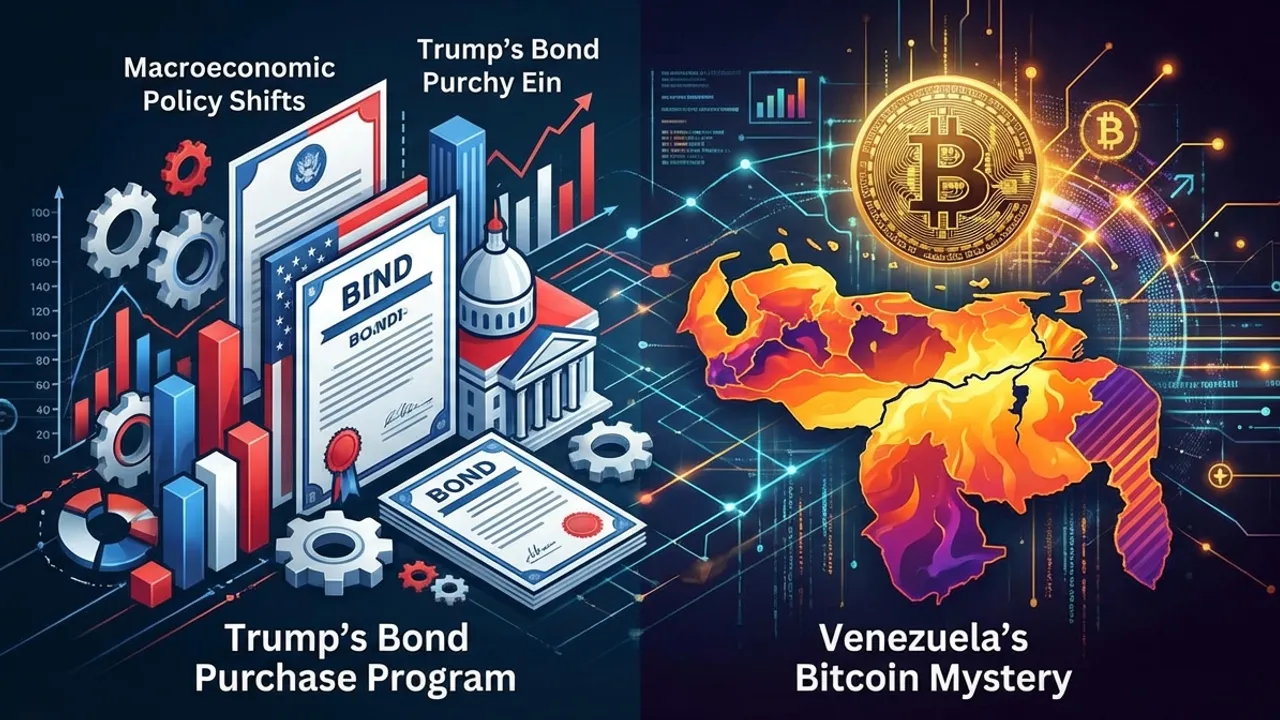
The Trump administration is planning a $200 billion program to purchase mortgage bonds, while unconfirmed rumors about Venezuela's massive Bitcoin holdings underscore the geopolitical significance of cryptocurrencies.
Trump's Intervention in the Mortgage Market
U.S. President Donald Trump has announced an extensive bond purchase program totaling $200 billion. The program is to be implemented through the government-controlled entities Fannie Mae and Freddie Mac and aims to lower mortgage interest rates and make homeownership more affordable [1].
The background to this measure is the strained situation in the U.S. real estate market: home prices have risen by approximately 50 percent since 2019, while the 30-year mortgage rate stands at over six percent—more than double the 2021 rate [1]. This combination is making homeownership increasingly unaffordable for American citizens.
Mechanism and Financing
The two institutions hold more than $200 billion in liquid assets, predominantly invested in U.S. Treasury bonds [1]. Fannie Mae and Freddie Mac are each permitted to hold up to $225 billion in mortgage-backed securities. At the end of 2025, their portfolios each stood at approximately $120 billion, leaving room for expansion [1].
In his announcement on Truth Social, Trump justified the decision by referencing his earlier opposition to selling the institutions: "Because I decided against selling Fannie Mae and Freddie Mac during my first term [...], [they] have 200 BILLION DOLLARS IN CASH" [1]. Bill Pulte, head of the U.S. Federal Housing Finance Agency, which oversees both institutions, has already confirmed that implementation is underway [1].
Controversial Assessments of Effectiveness
Analysts disagree on the program's efficiency. The majority expect it to lower mortgage rates—immediately following Trump's announcement, rates already fell [1]. However, the effect is likely to be temporary, as available funds are limited.
Prominent gold advocate Peter Schiff even warned of adverse effects. The reallocation from U.S. Treasury bonds to mortgage bonds could drive up Treasury yields and fuel inflation [1]. "While this might temporarily lower mortgage rates, it would stoke Treasury yields and inflation," Schiff stated [1].
Parallels to Quantitative Easing
The program bears similarities to the monetary policy measure of quantitative easing, in which central banks purchase long-term bonds. While the Federal Reserve directly controls short-term interest rates, it can also influence the long end of the yield curve through such purchases [1]. However, Trump's program is significantly smaller by comparison: during the coronavirus pandemic, for example, the Federal Reserve purchased $120 billion worth of long-term bonds every month [1].
Nevertheless, the announcement underscores the Trump administration's fundamental orientation toward a policy of cheap money and increased liquidity. Since December 10, the Federal Reserve has already resumed acting as a net purchaser of bonds—albeit at a volume of $40 billion per month and only for short-term Treasury bonds [1].
Impact on Bitcoin and Capital Markets
A loose money policy could have positive effects on Bitcoin and other assets, as observed during the coronavirus pandemic [1]. BlackRock CEO Larry Fink has already warned that the U.S. dollar could lose its role to Bitcoin if the United States fails to bring its deficits under control. The United States now pays more than one trillion dollars in interest on its $38.4 trillion debt burden [1].
Venezuela and the Bitcoin Mystery
Parallel to these macroeconomic developments, rumors about Venezuela's alleged Bitcoin holdings of nearly 600,000 BTC are causing a stir. However, these claims are unsubstantiated [2]. Official records and on-chain analysis only point to holdings of approximately 240 BTC, equivalent to a value of about $22 million [2].
Since the imposition of comprehensive U.S. and EU sanctions in 2015, Venezuela has increasingly turned to cryptocurrencies. Estimates suggest that at times over 30 percent of businesses used digital assets, while the country ranked among the world's leading nations in crypto adoption in 2020 [2]. Analysts believe that a significant portion of oil revenues is processed through stablecoins—some reports suggest as much as 80 percent [2].
Lack of Blockchain Evidence
Speculation about massive Bitcoin holdings traces back to reports by investigative journalist Bradley Hope, who suggested that the Maduro regime may have accumulated Bitcoin over the years [2]. However, no substantive blockchain evidence exists to date. Even proponents of the theory acknowledge that these are purely theoretical constructs [2]. Holdings of this magnitude would inevitably leave clear digital traces [2].
Regardless of their actual existence, the case demonstrates how deeply digital assets have become part of geopolitical strategies. Bitcoin functions not only as a store of value for citizens, but also as a potential instrument of state power and sanctions evasion [2].
Sources
AI-Assisted Content
This article was created with AI assistance. All facts are sourced from verified news outlets.